Downtown Los Angeles for First-Time Visitors: Where to Stay, Eat and Drink on Foot
13 September 2026 · 8 min read
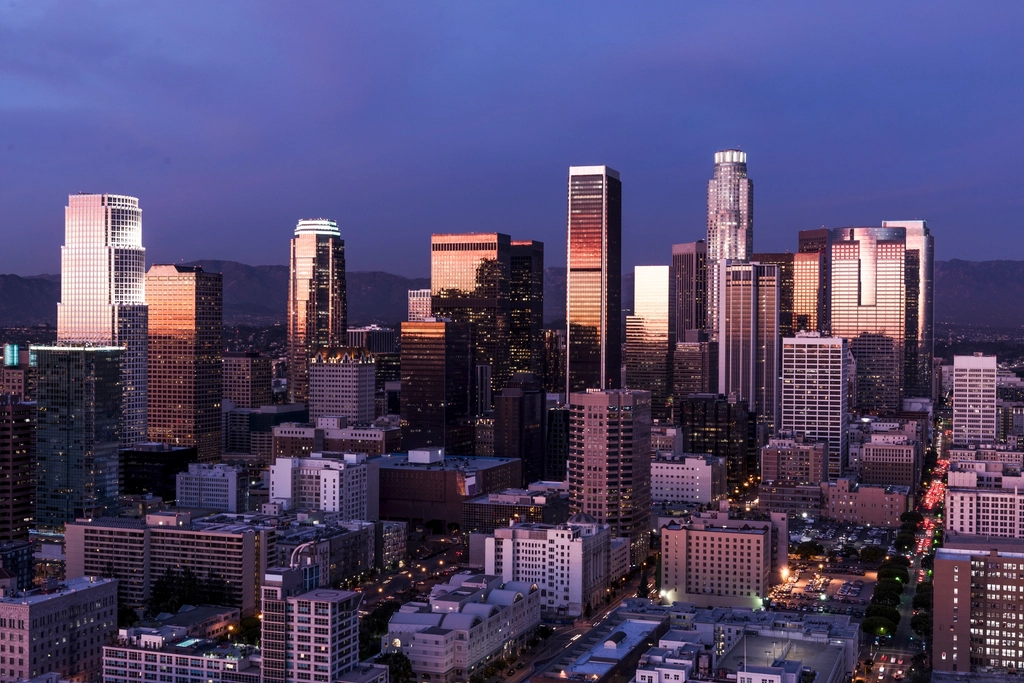
Downtown Los Angeles confuses first-time visitors because it does not behave like other American downtowns. It is not the center of the city in the way Midtown Manhattan or the Chicago Loop are; Los Angeles has a dozen centers, and downtown is only one of them. But it is the one you can actually walk, the one with the densest cluster of hotels, restaurants and bars, and the one where the Metro lines meet. If you have a night or two in LA without a car, or you simply want one base from which the rest of the city is reachable, downtown is the practical choice. This guide explains how the area is laid out, where to stay, what the eating and drinking scene looks like block by block and how to get in and out.
Photo by Carol M Highsmith via Rawpixel (CC0)
How downtown is laid out
"Downtown" covers roughly the area bounded by the 110 freeway to the west, the 101 to the north, the Los Angeles River to the east and the 10 to the south, about five square miles. Within it are a handful of distinct districts that each feel like a different town:
The Financial District, around Figueroa, Flower and Grand Avenue between 4th and 7th Streets, is office towers, the big hotels and the plazas. It empties out after seven on weeknights.
The Historic Core, along Broadway, Spring and Main between 3rd and 9th, has the old theaters, the loft conversions, most of the bars and the most street life. It is also where you will see downtown's homelessness problem most directly; it is real, it is concentrated on a few blocks toward Skid Row east of Main, and it does not generally affect visitors who stay on the main streets.
Little Tokyo, east of the Civic Center around 1st and 2nd Streets, is compact, clean and full of ramen, sushi and izakaya.
The Arts District, further east toward the river, is former warehouses turned into restaurants, breweries, galleries and expensive apartments. It is walkable from Little Tokyo but a long walk from the Financial District.
South Park and LA Live, around Olympic and Figueroa, is the arena, the convention center, the newer high-rise hotels and the chain restaurants that serve them.
Chinatown, north of the 101, is a short Metro hop or a twenty-minute walk from the Historic Core.
The distances matter. Walking from a Financial District hotel to the Arts District is about two miles, which in the summer heat is farther than it sounds. Plan by district, or use the Metro and ride-share to hop between them.
Where to stay
Downtown hotels fall into three tiers. The luxury towers around LA Live and Grand Avenue charge three hundred dollars and up and add a daily "destination fee" of thirty to fifty dollars, plus parking at fifty to sixty-five a night if you bring a car. Mid-range brand hotels in the Financial District run one hundred and eighty to two hundred and eighty. Converted historic buildings in the Historic Core, which are the most interesting, sit anywhere from one hundred and fifty to three hundred depending on the night, and their rooms vary a lot, so read recent reviews about noise and elevators.
One of the newer high-rise options in South Park, a few minutes' walk from the arena and the convention center, is this one:
Whatever the tier, ask three things before booking: whether the quoted rate includes the destination fee, what parking costs, and how far it is from a Metro station. A hotel a block from 7th Street/Metro Center or Pershing Square makes the rest of the trip easier.
Budget travelers should look at the hostels and shared-room options, which downtown has more of than any other part of the city, but read the reviews carefully; quality swings from excellent to grim within a few blocks.
Coffee and breakfast
Downtown starts early on weekdays because of the office crowd, and the coffee scene has grown up around them. Independent roasters and third-wave cafes cluster on Grand, Figueroa and Spring, and most open by seven. The Financial District cafes are the most convenient if you are staying in a tower hotel:
Weekend brunch is the one meal downtown does at full strength on Saturdays and Sundays, when the office workers are gone and the residents come out. Expect a wait of twenty to forty minutes at the well-known spots between ten and noon, and note that many of them stop serving breakfast dishes at two or three. Grand Central Market on Broadway, a covered food hall that has been operating for more than a century, is the fastest way to feed a group with different tastes; stalls range from tacos to Thai to coffee and it opens at eight.
Lunch and dinner by district
The Historic Core and the Financial District are where the sit-down restaurants concentrate, from the polished dining rooms in the 7th Street shopping complexes to the rooftop places at the top of the office towers. A dinner reservation on a Friday or Saturday is worth making a few days ahead; on a Tuesday you can usually walk in. Two of the most-reviewed dining rooms in the area, one on 7th Street and one in a converted historic building near the Civic Center, show the range:
Downtown is also where the city's Mexican food is closest to hand for a visitor without a car, from the taco stands at Grand Central Market to the restaurants along Spring and Broadway. This Historic Core address, inside an old arcade building, is one of the most reviewed:
Mexican & Tex-Mex Restaurants · Los Angeles, California
BROADWAY ARCADE BUILDING, 541 S Spring St Unit 101, Los Angeles, CA 90013
★★★★★4.6(2,411)
Little Tokyo is the easy answer for lunch. The blocks around 1st and 2nd Streets have more ramen shops per block than anywhere else in the region, plus udon, sushi and Japanese bakeries, and prices are lower than in the Financial District. Lines form at the popular ramen counters from noon to one and again at six; go at eleven-thirty or two-thirty to skip them. This ramen bar on 2nd Street is one of the better-rated newer arrivals:
After dinner, the Historic Core and the Arts District are the two places where people actually walk around. Ice cream is the excuse. On Spring Street, this parlor sits among the bars and lofts:
The walk between the two is about a mile and a half along 3rd or 4th Street through Little Tokyo. It is pleasant in the early evening and less so after eleven, when the streets empty; take a ride-share back if you are unsure.
Bars
Downtown's bar scene is the best in the city for people on foot, because the Historic Core packs cocktail bars, whiskey rooms, dive bars and rooftop lounges into about ten blocks. Most open at five or six, get busy after nine and close at two, which is last call everywhere in California. Rooftop bars often have a dress code and a cover on weekends; the ground-floor places rarely do. Two of the best-known on 7th Street and Spring Street:
Carry ID. California bars check anyone who looks under thirty, and many will not let you in without a physical government ID even if you are clearly older.
Getting there and getting around
From the airport: the LAX FlyAway bus runs from every terminal directly to Union Station on the north edge of downtown, takes about forty-five minutes to an hour depending on traffic and costs under fifteen dollars. Ride-share from LAX to downtown is forty to seventy dollars and half an hour to an hour. The Metro rail connection from the airport, via the new transit center, is cheaper but slower with a transfer.
Within downtown: the Metro B and D subway lines run under 7th Street and Broadway between Union Station and the Financial District, and the A and E light-rail lines cross at 7th Street/Metro Center, which is the hub. A ride is under two dollars with a TAP card, which you buy at any station. DASH buses, the small local circulators, cost fifty cents and cover the districts the rail does not. Ride-share within downtown is ten to twenty dollars and can take longer than walking in the evening rush.
Driving: do not, if you can avoid it. Parking downtown runs ten to twenty-five dollars for a few hours in a lot, fifty and up overnight at hotels, and street parking is scarce and strictly enforced. If you have a car, park it once and walk.
Safety and practicalities
Downtown is safe on the main streets during the day and in the busy districts at night. The blocks east of Main Street and south of 5th toward Skid Row are where the encampments are, and the sensible approach is the same as in any big city: stay on lit, busy streets after dark, keep your phone in your pocket rather than your hand, and take a ride-share rather than a long walk through empty blocks late at night.
Summer afternoons reach the nineties Fahrenheit and the concrete holds the heat, so plan indoor time from two to five. Winter is mild but rainy days do happen and downtown floods in odd places. Most restaurants take cards; some taco stands and market stalls are cash only, so carry a little.
A sample two-day plan
Day one: coffee in the Financial District, the Central Library and the Bradbury Building in the morning, lunch at Grand Central Market, the Broadway theaters and the Historic Core in the afternoon, dinner near 7th Street and a bar crawl on Spring.
Day two: Little Tokyo for a late breakfast at a Japanese bakery, the Arts District galleries and a brewery at lunch, an afternoon ride on the Metro to Griffith Observatory for the view (it is free, and the bus from the Vermont/Sunset station runs up the hill), and back downtown for ramen and ice cream.
That covers the essentials without a car. Every business mentioned above is listed on this site with its address, hours, phone number and the latest Google rating, and the Los Angeles page shows hundreds more by category if you want to build your own itinerary.
Every dog owner eventually faces the same question: what do we do with the dog when we travel, or when work runs twelve hours a day? Boarding kennels, pet…
What separates a careful groomer from a fast one: the questions to ask on the phone, what to look for on the first visit, how to read reviews and what a fair price looks like in 2026.
petsdog groominghow-to
Welcome to Local USALet me help you find a great place today!